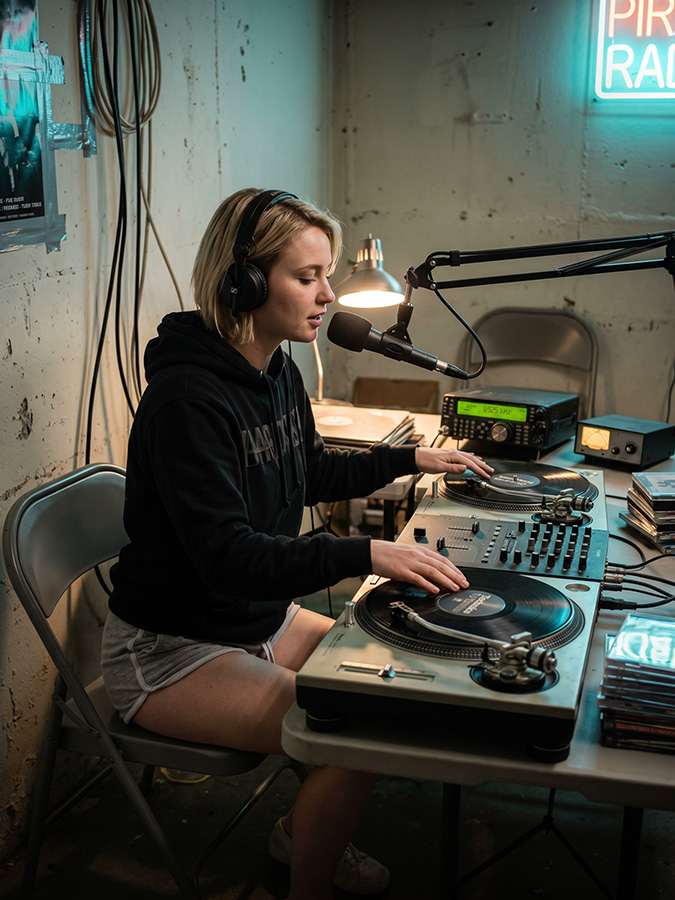
 Pirate Shortwave Radio Pirate Shortwave Radio
.
.
"Don't
Let Them See Us, Don't Tell Them What We Are Doing."
- Broadcasting From The Middle
of Nowhere
.
VISIT
MY PIRATE RADIO STUDIO-QUALITY EPISODES ARCHIVE HERE...
.
SEE BELOW FOR MORE PIRATE RADIO
ARCHIVES...
.
Pirate radio is one of the last real frontiers of
radio
where curiosity is still rewarded, the programming is of the most
creative to be found on any medium
and mystery is part of the experience. Unlike commercial
broadcasting or amateur radio, pirate stations operate outside of
official licensing systems (illegal broadcasting), with unusual
content, generally from unknown locations with unknown schedules by
anonymous operators, and that’s exactly why people listen!
The following is a light guide on how to listen in.
For most of my life before ham radio, I
was
a dedicated SWL (Shortwave Listener) and for years was captivated by
the clandestine signals, numbers stations and unlicensed broadcasters
found in the hidden places within the world band. In fact, my
adventures with the pirate radio scene actually lead me to
becoming a licensed ham radio operator.
For a shortwave listener, pirate radio
offers
something that modern media rarely provides: surprise. You’re
not
just streaming content, you’re hunting it. One night you
might
hear forgotten 80's synthpop echoing into the ether, and another night
might bring strange spoken-word programs, comedy skits, political
commentary, or a surreal audio collage. You never know what’s
coming on next and sometimes you don’t even know who is transmitting.
.
.
What to Expect When Listening:
Pirate stations, particularly in North
America
generally operate in the shortwave spectrum beyond the traditional
"world band broadcast" frequencies. Many stations appear in
the 43-meter band
(around 6900-7000 kHz), as well as the 48, 41, and 60 meter bands.
A few good frequencies to try are 6925, 6935, and 6975 kHz.
SEE HERE FOR A MORE COMPLETE FREQUENCY
LIST...
.
What you WON'T hear are
commercials and
sponsor slots, call signs read every 10 minutes, program schedules
published in advance, consistent transmit times and FCC
compliance
messages.
What you WILL hear is
awesome uncommon and rare music, mystery, science fiction and radio
drama,
humor, protest banter, nostalgia programming, experimental audio,
one-person stations with homemade transmitters and makeshift studio
setups, and broadcasts that vanish in the blink of an eye. All
uncensored!
Some
stations may only broadcast once while others appear randomly for
years, and reception ranges from crystal clear to deep-fading ghosts of
a signal (QSB)
drifting through the noise.
.
.
How to Tune In:
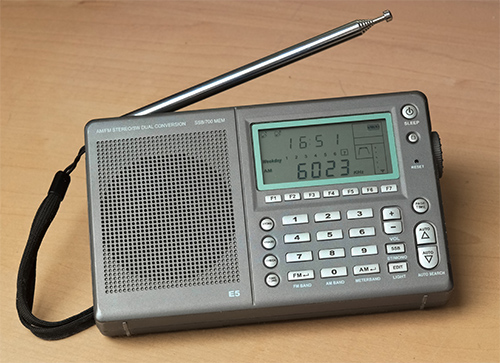
To listen in is obvious, you’ll need a shortwave receiver.
Either a portable or desktop receiver
specifically designed for world band
reception, and there are a few musts that are required, including
digital tuning, the ability to receive both AM and SSB (Single
Side-Band) high and low, and designed for the connection of an external
antenna.
Cheap receivers, especially those with only analog dials or
the
lack of SSB should be avoided. Any HF ham radio made in the
last
50 years with the ability to receive in pirate frequencies should work.
Most likely, if you're reading this page, you're either an
SWL
or ham so this may be known to you, if not, then welcome to the world
of shortwave listening!
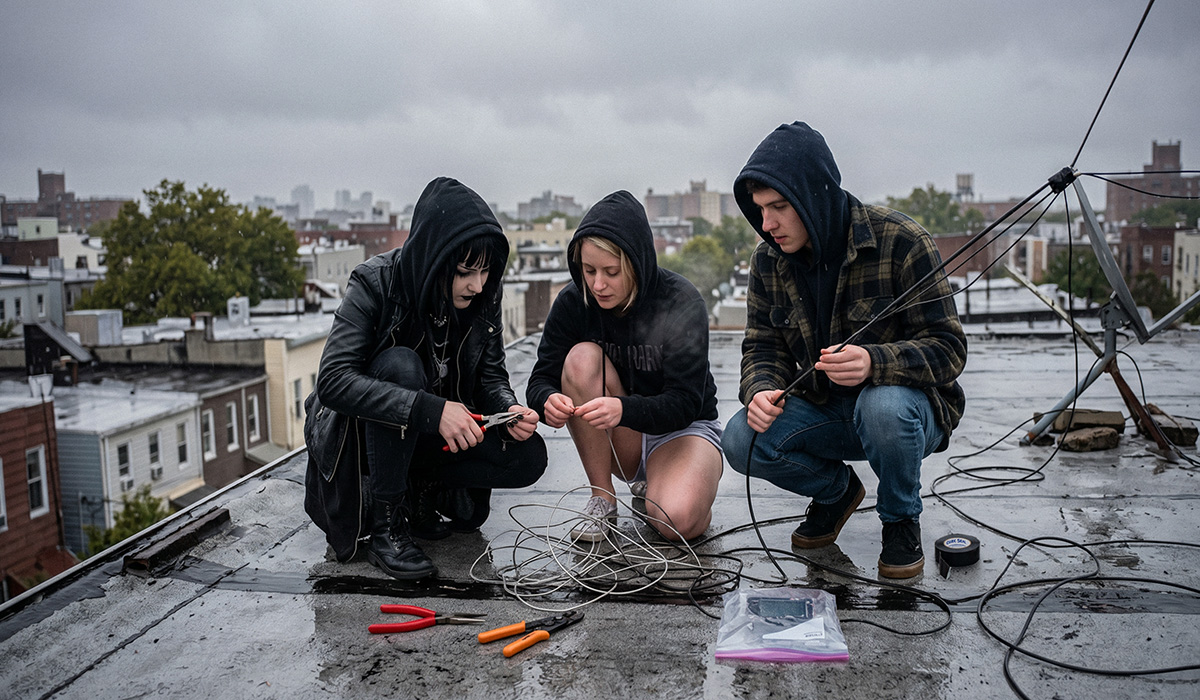
It is highly suggested you set up at
least a basic
outdoor antenna, you'll pick up ten-fold more stations with a
60'
random
wire out to a tree than the built-in whip antenna. There's no need for
grounding, coax cable or anything like that. Just be aware
that a
longer antenna may present too much signal gain for a cheaper radio, so
try
adding an attenuation circuit if overloading is an issue.
And the two most important requirements needed to catch a pirate
broadcast are both patience and curiosity!
Tune slowly across the known
spots or lean on
reports
from sites such as HF Underground
for exact known frequencies while it happens, listen for non-commercial
or unusual-sounding signals and take notes when you hear something
interesting. The majority of broadcasts will be made in SSB,
so
hearing music in a mode generally only used by hams for voice
communications on the ham bands is
a dead giveaway. If the signal is in AM, then it's usually a
stronger signal and you're in for a treat from a veteran op.
So
if you
hear
music that doesn’t match any standard known station format, a host
speaking with no ID or giving an odd name, long periods with only a
carrier
signal, vintage commercials and clips, parody
announcements, odd sound bites, or the infamous "hahahaha,
fookin'
schlob" then you may have found a pirate.
.
When to Tune In:
Most
pirate activity takes place during the weekends, holiday and special
days of year with most operators broadcasting during the evening
twilight through
early nighttime hours when signals propagate best across North
America and Europe. It's not uncommon to catch a few pirates
daily during the weekdays and during holiday sprees, expect many to
broadcast through the night into the morning.
.
It's Not Illegal... To Listen:
In the US, the FCC has no rule or law
that
prohibits tuning in to or listing to unlicensed broadcasts and will
generally safeguard
your right
as a radio listener to be able to listen to most frequencies without
excessive undue interference from intentional or technically negligent
parties. However, your receivers are generally classified as
being required to accept interference. But no, the FCC is
only
concerned with the person(s) operating from or controlling any
RF-emitting device done so without a license.
Since the late 1990's,
because of the advent of the Internet, cellular communications and
advancing technology, the FCC has made a shift from enforcement of the
HF frequencies to that of local FM broadcast frequencies and other
services,
not to say they aren't seeking for HF pirates, but FM pirates have been
made for hard targets over the last two decades while shortwave pirates
have had room to spread their legs. The only
restricted frequency bands you're not allowed to listen to without an
explicit granted license, naturally
includes cellular phone and the decoding of first-responder or other
special service encrypted
digital communications.
It's also not illegal in the US to
correspond (via the USPS, email or social media) or even seek commerce
with
unlicensed broadcasts, barring anything else like mail fraud which is
outside the scope of unlicensed broadcasting. There are laws protecting
correspondence through the mail service. However, in other
parts of the world, especially the UK, it may actually be illegal to
listen to pirates (not to mention, TV and radio receivers may still be
government licensed for use), so do your own due diligence on the
matter.
.
.
Logging & Reporting: The
Listener Community
One of the best parts of pirate radio is the listener
community.
Most pirates want to be heard, even though they operate outside
regulation. Listeners help document broadcasts, confirm
reception, and
keep the scene alive. I myself, back in the day would turn
the
Radio Shack DX-440 on every evening after work and post every detail I
could receive on the (now defunct) Free Radio Network
(ACE/FRN.net) where
each of us often helped clue other listeners in on details for where
and how they could catch any particular pirate who would plunder the
shortwaves.
The primary online hub for
North American pirate radio listeners is HF
Underground https://www.hfunderground.com
You can also find "HF
Underground" on Facebook.
Listeners post reception reports which
include times in UTC (Coordinated Universal Time),
frequencies, modes, signal quality, recordings, comments on
programming,
speculation on station identity and often, pirate operators themselves
reading these reports and respond, sometimes publicly or even through
the airwaves on live or later broadcasts.
.
QSL Reply Cards, Reception
Reports, and
Postal Drops
One of the most rewarding parts of being a pirate-SWL is sending
reception
reports and occasionally receiving a QSL reply in return. A
reception
report tells the station operator details that verify the listener's
reception of their broadcast including the frequency, broadcast time
(in UTC), signal strength ([S]ignal, [I]nterference, [O]verall quality
from 1=worst to 5=best), audio quality, program details, the
listener's location and receiver/antenna setup.
Pirate
operators
often
appreciate detailed, accurate reports, especially when reception
conditions were poor or uncertain, and many pirates highly appreciate
friendly correspondence. Reports help confirm if a
transmission worked, how far it traveled and what kind of signal
quality listeners experienced. Often, and most likely
required
from the listener is the inclusion of at least 3 first-class postage
stamps or $5 or so to defray postage between the operator, postal
drop(s) and the listener.
.
.
Some stations reply by email, others acknowledge reports on-air, and a
few still send QSL cards in the mail which are confirmation postcards
or letters
verifying the listener's reception. These mailed replies can
be
custom
printed
designs, handmade artwork, or simple typed notes. Some
replies
include very unique items such as prizes and audio CD's of the
programming. Collecting
QSLs
has long been part of shortwave culture, and pirate QSLs are often more
creative than anything issued by commercial broadcasters.
Because pirate stations aim to protect their location (for very obvious
reasons), they rarely provide direct mailing addresses.
Instead,
many use postal drops, P.O. boxes, intermediaries, or third-party mail
services to receive listener mail safely. When available,
these
addresses are sometimes announced on-air or quietly shared through
listener forums along with any required postage information.
Postal drop people are generally dedicated fans and listeners
who
the operators have entrusted to keep their mailing and contact
information safe from government or prying fans. It takes a
bit
of work and often times, extra money to help keep the
QSL/correspondence system going, so be friendly to them as the drops
are actual fans like you, and offer a little extra as a tip for good
measure on getting that coveted rare QSL reply back.
Not every
station will reply and some never do. Some reply only once
and
others reply years later when you least expect it. That
unpredictability is part of the experience. Sending a
reception report isn’t about demanding confirmation, it’s
about contributing to the living record of an underground
broadcast. When you do receive a QSL reply card, it becomes
something special, proof that at one moment, somewhere in the night, a
signal crossed the dark and found you. So if
you receive a QSL from an operator, even if it's a Zerox'ed form card,
appreciate it because you've got something rare in your hands.
.
.
The Personalities of Pirate Radio
Part of what makes pirate radio unique is the character behind each
station. You’re not hearing a corporation, you’re hearing an
individual. Some stations are polished and professional, some
are
crude and chaotic, some are political or satirical and some are focused
on music. Some are experimental and bizarre, some are
nostalgic
and some are mostly story-driven. It's still the wild west,
and
without the need for shareholder return, sales numbers and "payola",
the
unlicensed broadcaster/creative content producer are free to really
express what's on their minds.
A few of the most well-known pirates over the years include:
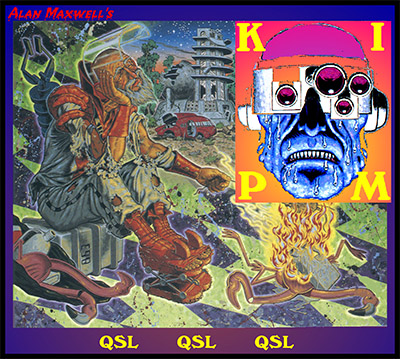
Alan Maxwell
- Operator of KIPM (Illuminati Prima Materia), known for hilarious
fiction, radio satire, introspective contemplation and creative
storytelling disguised as “radio reality.”
Commander
Bunny - An unpredictable personality famous for
off-the-wall humor and absurdist broadcasts.
Dr. Benway
- Operator of Undercover Radio portrays himself not as a defiant
outlaw, but as a hobby broadcaster and storyteller who loves radio and
frames his broadcasts as an expression of free speech though pirate
broadcasting. Plays a mix of rock music and clips of William
S.
Boroughs, Laurie Anderson and Timothy Leary.
Wolverine
Radio - A long-running station often featuring classic
rock and polished intros.
Captain
Ganja
- One of many personae and one of many operators creatively and
unapologetically celebrating the use, enjoyment and culture of canibus.
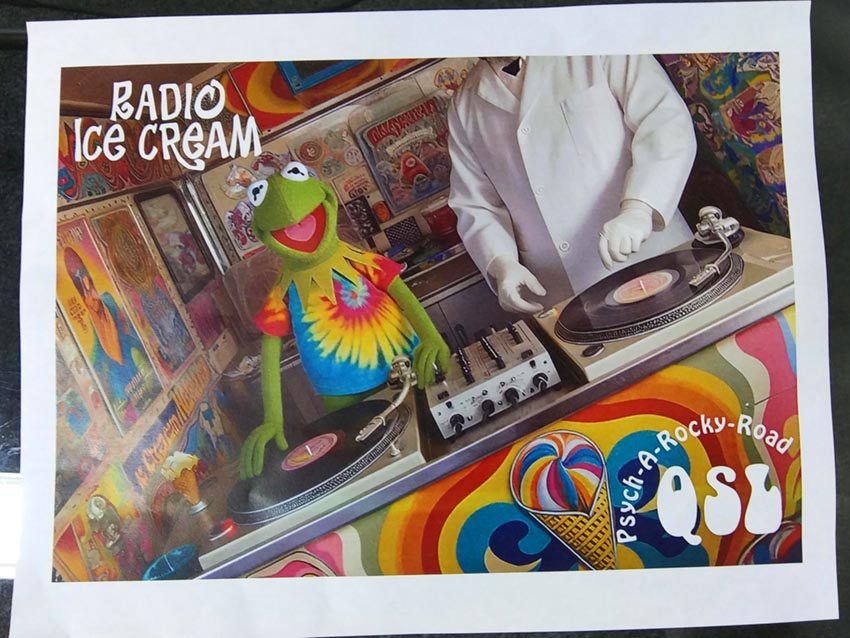
Radio Ice
Cream
- Featuring The Ice Cream Man and Kermit The Frog in their ice cream
truck playing a mix of
classic tunes (focusing on various genres) along with comedic skits
and
commentary on music artists and their records.
Radio Free
Whatever - Known for eclectic content and spontaneity.
New operators appear regularly, and every year brings fresh voices,
strange pseudonyms, and creative experiments.
.
A Curious Corner of Radio
Even experienced ham operators are sometimes surprised by pirate radio
as these clandestine stations lurk in the outskirts of their
comfortable spaces. While amateur radio emphasizes proper
protocol and technical discipline, pirate radio is closer to
performance art with a transmitter. Skill still matters but
so does
imagination.
Some broadcasts are made
from remote mountain cabins, some from RV camp sites, some from cars,
and some from park benches and hiking trails. Some operators
use different antennas and transmitters with each broadcast.
Some broadcast content that is live and produced on-site
during transmit sometimes with live banter and commentary with other
pirates as well as with listers posting online, while some broadcast
original content provided by other creators (often teased as "studio
pirates") who may not have the skill or where-with-all to transmit.
Some operators may relay (or re-broadcast) other
operator's content. This helps to throw off the scent of the
FCC as well as giving an operator more opportunity for better signal
coverage to reach their audience. In all cases, the true
origin and methodology of a pirate broadcast is unimportant, it's the
fact that it's a pirate radio broadcast and is mysterious and unusual
by nature.
Shortwave
pirate radio isn’t about efficiency and technical proficiency, it’s
about presence, sending sound into space and seeing who hears
it. If
you’re
the kind of person who likes mysterious signals, forgotten music,
underground culture, a late-night audio discovery, or have a strange
nagging feeling to
partake in something a little naughty, then you’ve found your place.
Grab a
decent shortwave receiver and start tuning. Somewhere,
someone is transmitting
just for you!
.
VISIT MY ARCHIVE of PIRATE RADIO
BROADCASTS - In Studio Quality
Original Audio
.
HERE at ARCHIVE.ORG
.
At the following ARCHIVE.ORG links you
will find my
curated collections of studio-quality broadcast content audio
files provided by a few pirate shortwave operators. Most are
offered
as
~192 kb/s .MP3 files and/or original "CD" quality .WAV or .FLAC files,
and you can
listen to each show through the Archive.org player list at the top of
each page.
These recordings were
obtained both though QSL reply gifts as well as in bulk collections
through kind collaboration of particular operators. In fact,
the
KIPM library was built from a small collaboration with other listeners
on the FRN. The
purpose
of these collections are to preserve the legacy of these unique
stations, especially as there are a couple of operators who have
already
passed from this life. I (K4ICY) have been fortunate in
having
sparse
correspondence
with these operators over time , with material provided generally
through postal-drop mail, so of
course, I'm missing many shows from each op., perhaps at one time
available via QSL mail from
each operator. If you have any original studio-quality master
audio material (not from over-the-radio recordings, but actual "studio"
audio
files) available that I do
not have presently, I will be very glad to add them to the collection.
.
 Undercover Radio - with Dr. Benway
.
 KIPM (Illuminati Prima Materia) - with Alan
Maxwell
KIPM (Illuminati Prima Materia) - with Alan
Maxwell
.
 Radio Ice Cream - with The Ice Cream Man and
Kermit The Frog
Radio Ice Cream - with The Ice Cream Man and
Kermit The Frog
.
 Illumination Radio - with The Illuminoids
(Jells Mayhem and Howie Pyro)
Illumination Radio - with The Illuminoids
(Jells Mayhem and Howie Pyro)
.
.
ARCHIVES FROM OTHER ENTHUSIASTS
.
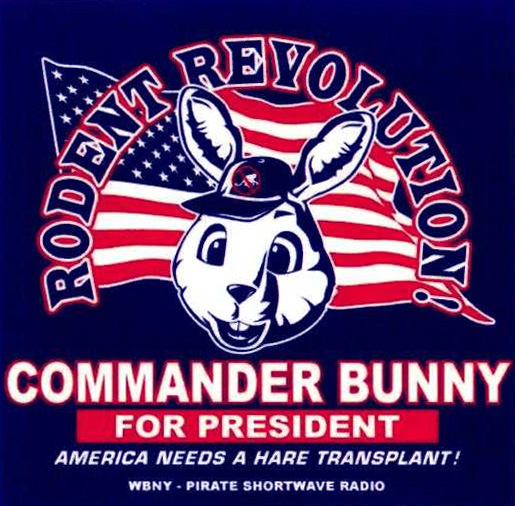 WBNY
Commander Bunny 2008, WBNY
Commander Bunny 2009,
WBNY
Commander Bunny 2010
WBNY
Commander Bunny 2008, WBNY
Commander Bunny 2009,
WBNY
Commander Bunny 2010
.
...More Archives by Ragnar Daneskjold
.
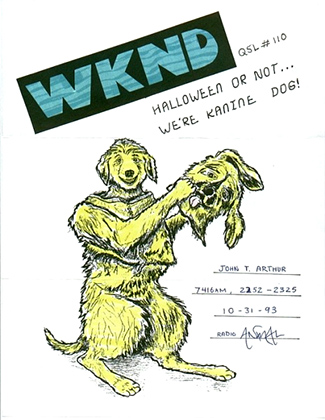 WKND Studio Archive with Radio Animal (by
Ragnar)
WKND Studio Archive with Radio Animal (by
Ragnar)
.
 Grasscutter & Sunshine Radio
.
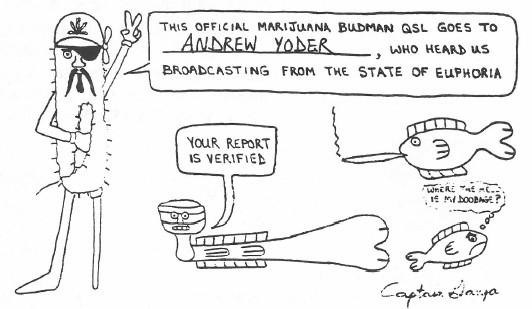 Captain Ganja, Radio Free Euphoria, Voice of
the Runaway Maharishi, WPUP, 6YCAT, and more...
Captain Ganja, Radio Free Euphoria, Voice of
the Runaway Maharishi, WPUP, 6YCAT, and more...
.
 Sealord's Shortwave Pirate Radio Studio
Recordings
Sealord's Shortwave Pirate Radio Studio
Recordings
.
A treasure trove, dare I say, the "pirate's booty"
of original pirate shortwave studio recordings!
Thanks to Sealord, you can
hear select studio recordings from the following:
6YVOS
(Voice of Smoke), Altered States Radio, Amiga Computer Generated Radio,
Anarchy 1, Art Bell Rants, Bob Dylan Radio, CSIC, Caribbean Sound
System, Fake Radio Is Not USA, Freedom 40, High Times Radio, KIPM,
KTVI, Midnight Radio, NAPRS, Numerical Deception, Pan Global Wireless,
Pirate Radio Insanity, Quantum State Laboratory, RBCN, RFS, Radio 43,
Radio 69, Radio Airplane, Radio Apocolypse Test Loop, Radio Azteka,
Radio Deadman, Radio Doomsday, Radio Esoterica, Radio Free Euphoria,
Radio Garbanzo, Radio Halloween, Radio Ice Cream, Radio Nonsense, Radio
USA, Radio Xanax, Satan Radio, Spam Radio, Tangerine Radio, The Asylum,
The Crooked Man, The Crystal Ship, The Free Hope Experience, Up Against
The Wall Radio, Voice of The Daleks, Voice of The Dead, Voice of The
Runaway Maharishi, Voice of The Unknown Monkey Spanker, Voice of Hell,
Voice of The Conscience of America, Voice of The Real World, WEAK,
WEED, WKND, and WREC.
.
.
More to come...
Enjoy hours of original non-corporate, non-payola radio content!
.
Edited: 09/17/26
(C) 2026 Copyright - Michael A. Maynard |
|